|
|
| THE WORLD SERIES |
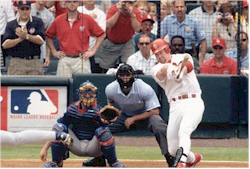 World Series,
major league baseball's annual championship series, played between the
winners of the National League (NL) and the American League (AL)
playoffs. The first team to win four of the series's seven games
becomes the World Series champion. (In 1903 and from 1919 to 1921 the
first team to win five out of nine games became champion.) The World
Series is the most popular event in baseball. Thousands of fans fill
the stadiums where the games are played, and millions more follow the
series on radio and television. World Series,
major league baseball's annual championship series, played between the
winners of the National League (NL) and the American League (AL)
playoffs. The first team to win four of the series's seven games
becomes the World Series champion. (In 1903 and from 1919 to 1921 the
first team to win five out of nine games became champion.) The World
Series is the most popular event in baseball. Thousands of fans fill
the stadiums where the games are played, and millions more follow the
series on radio and television.The World Series is held in October and concludes the major league baseball season. Beginning in early April, NL teams and AL teams play 162 regular-season games for the right to compete in their league's postseason playoffs. These separate playoffs match the best four teams in each league. They determine who wins the pennant, or championship, of each league. The two pennant winners play in the World Series. The first contests resembling the World Series were held during the 1880s, when the leading baseball clubs of the two major leagues�the National League and the American Association�agreed to play in exhibition games following their regular seasons. The name World Championship Series arose during this period, when promoters and journalists sought to arouse interest among fans. These championship series were often unsuccessful, marked by disorganization, weak fan support, and disputes among baseball clubs. The series was not held every year and ended completely after the 1891 season, when the American Association folded. The American League was founded in 1901 and became the chief rival of the National League. The first World Series was held in 1903, when Barney Dreyfuss, owner of the NL champion Pittsburgh Pirates, challenged Henry Killilea, owner of the AL champion Boston Pilgrims (later called the Boston Red Sox), to a best-of-nine-games series. The first game was played in Boston, Massachusetts, on October 1, before a crowd of more than 16,000 fans. The Pilgrims, led by the great pitcher Cy Young, lost the first game, but won the series 5 games to 3. The 1903 World Series was a tremendous success. Thousands of fans attended every game, traveling by train between the two cities, and the players responded with exciting performances. The following year, however, the series was not held. In 1904 the Boston Pilgrims were scheduled to play the New York Giants (later the San Francisco Giants). But Giants owner John T. Brush and manager John J. McGraw had quarreled repeatedly with the founder and president of the American League, Ban Johnson. As a result, the Giants refused to play. Public criticism was so great that the Giants, who were again NL champions the next year, agreed to play the AL champion Philadelphia Athletics (later the Oakland Athletics) in the 1905 World Series. The two leagues created an agreement that became the foundation for modern World Series competition. The Giants won the series in five games. Christy Mathewson of the Giants pitched three games without allowing a run. The most notorious World Series in history took place in 1919, when the Cincinnati Reds beat the Chicago White Sox in eight games. The following year, seven White Sox players were accused of fixing, or intentionally losing, the series in return for bribes from professional gamblers. The seven players�Eddie Cicotte, Happy Felsch, Chick Gandil, Shoeless Joe Jackson, Fred McMullin, Swede Risberg, and Lefty Williams�were banned from baseball for life. Buck Weaver, who did not take a bribe, was banned because he knew of the fix and did not report it. The 1919 team became known as the Black Sox. The World Series reached more fans during the 1920s with the development of radio broadcasts. By the 1930s the American and National leagues and the radio networks had arranged regular, live, play-by-play broadcasts of the World Series. The 1920 World Series, which matched the Cleveland Indians and the Brooklyn Dodgers (later the Los Angeles Dodgers), became memorable for one of baseball's rarest feats�the unassisted triple play. In the fifth inning of the fifth game, Cleveland second baseman Bill Wambsganss put three Dodgers out in one play by catching a line drive, stepping on second base to put out a runner before he returned, and tagging a runner returning to first base. The 1921 World Series was played entirely in New York City, between the New York Yankees and the New York Giants. It was the Yankees' first appearance in the series, and they lost in eight games. But it marked the beginning of an era in which the Yankees would dominate baseball, becoming the most successful team in World Series history. The Yankees won their first World Series in 1923, and they won again in 1927 and 1928 with one of baseball's most powerful lineups of hitters. The greatest among them was Babe Ruth, who joined the club in 1920. But the Yankees of the 1920s also included Lou Gehrig, Tony Lazzeri, Earle Combs, and Bob Meusel. The Yankees continued to dominate the World Series during the 1930s, under the leadership of manager Joe McCarthy, who earned his first series victory in 1932, when the Yankees swept the Chicago Cubs in four games. Outfielder and powerful hitter Joe DiMaggio joined the Yankees in 1936, adding to their star lineup and helping them win another series in his rookie season. The Yankees won again in 1937, 1938, and 1939. The World Series continued to be played during World War II (1939-1945), but all of baseball faced difficulties. Many of the best players were drafted into military service, and wartime regulations limited travel and the manufacture of equipment. But the series provided welcome entertainment to war-weary Americans. The Yankees continued their success, with World Series victories in 1941, 1943, and 1947. The St. Louis Cardinals ranked as one of baseball's best clubs during the 1940s. Great players such as Enos Slaughter and Stan Musial helped the Cardinals win the World Series in 1942, 1944, and 1946. From 1949 through 1953, Yankees manager Casey Stengel led his club to five consecutive championships. The 1954 World Series included one of the most dramatic fielding plays in history. In the eighth inning of the opening game, the Cleveland Indians and New York Giants were tied. Cleveland's powerful hitter Vic Wertz hit a hard line drive to deep center field. Giants center fielder Willie Mays turned and ran at full speed, his back to the infield, and, without looking back, caught the ball as it sailed over his left shoulder, about 460 ft (140 m) from home plate. Many fans saw this play as the turning point of the series, and the Giants went on to win it in four games. The Brooklyn Dodgers won their first World Series in 1955, after losing six series since 1920. In 1956, Yankee Don Larsen pitched the first World Series no-hitter; in a perfect game, he retired 27 consecutive Dodger batters without allowing a base runner in a 2-0 Yankee victory. Television brought a new dimension to the World Series after World War II. The new technology was first applied to the World Series in 1946, when games between the Cardinals and the Boston Red Sox were broadcast locally in Boston. Baseball on television grew in popularity during the 1950s, as more homes acquired television sets and broadcasters improved their coverage of the games. During the 1960s, black-and-white telecasts were replaced with color, and major networks negotiated exclusive rights to broadcast postseason games. Networks provided detailed World Series coverage, featuring close-up images of play, instant replays of exciting moments, and analysis from baseball commentators. Television enabled fans to closely follow each play from their homes. The Yankees' era of domination ended during the 1960s. One of the team's most dramatic losses came in the 1960 World Series, when it faced the Pittsburgh Pirates. The series extended to the seventh game, when Pirates second baseman Bill Mazeroski hit a game-winning home run at the end of the ninth inning, to give Pittsburgh its first championship since 1925. The Yankees won the World Series in 1961 and 1962, and then lost in 1963 and 1964, marking the end of an extraordinary period of World Series success. World Series competition became more balanced after the mid-1960s. The NL and the AL each added new teams, and several existing clubs moved to new cities. The New York Mets, formed in 1962, became responsible for one of the biggest surprises to arise from baseball's expansion. In their first few years, the Mets gained a reputation as one of baseball's poorest teams. But in 1969, they shocked the baseball world by winning 100 regular-season games. They then proceeded to defeat the heavily favored Baltimore Orioles, 4 games to 1, in the World Series. The Oakland Athletics emerged as one of baseball's best teams in the 1970s. Led by stars such as Rollie Fingers and Reggie Jackson, Oakland won the series in 1972, 1973, and 1974. After joining the Yankees, Jackson became a star of the 1977 World Series by hitting four consecutive home runs against the Dodgers during the fifth and sixth games. The 1980s saw a string of World Series champions. No team managed to win two in a row, and 11 different teams won from 1979 through 1991, with the Los Angeles Dodgers and the Minnesota Twins each winning twice during the span. The leagues also were almost evenly represented�seven NL teams and six AL teams won during those years. In 1992 and 1993, however, the Toronto Blue Jays won consecutive World Series. Their victory in 1992 made them the first club based outside the United States to win the major league championship. Because of a strike by major league players that lasted from August 1994 to April 1995, no World Series was played in 1994. In 1995 the Atlanta Braves won the series. A year later the Yankees began a championship streak, winning four World Series titles in five years. The only interruption of this streak came in 1997, when the Florida Marlins won the series in only their fifth year of existence. In 2000 the Yankees and Mets squared off in a so-called Subway Series, the first series involving two teams from the same city since 1956. The Yankees won, giving the franchise its third straight title and 26th overall. |
